


We didn’t understand compound interest. We couldn’t explain a mutual fund. We had absolutely no idea how a mortgage worked.
But we knew that 1989 Upper Deck Ken Griffey Jr. rookie card was going to be worth thousands someday. We knew it. We had seen the price guide. We had heard the guy at the card shop. And we were prepared to make some very aggressive financial decisions based on a piece of cardboard with rounded corners.
We were going to pay for college. Maybe buy a car. Possibly retire early.
Welcome to the baseball card boom of the late 1980s and early 1990s: a golden age of collecting, speculation, binders, plastic sleeves, and financial optimism that would make a cryptocurrency influencer blush.
The Great Baseball Card Gold Rush: When Every Kid Became a Wall Street Investor
Before every kid had a smartphone, a gaming subscription, and access to a financial influencer explaining how to turn $40 into $400,000, we had baseball cards.
It was a beautiful, uncomplicated plan:
- Buy packs of baseball cards.
- Find the good players.
- Put them in plastic sleeves.
- Store them in binders.
- Wait 20 years.
- Sell them for enough money to pay for college, buy a house, or at least purchase a really nice used car.
We didn’t call it investing. We called it collecting. But make no mistake, we were running miniature hedge funds out of our bedrooms.
Every pack was a potential lottery ticket. Every unopened wax box was a speculative asset. Every card featuring a young superstar was an opportunity to diversify our cardboard holdings.
Our parents thought we were wasting money. We thought our parents lacked vision; convinced that the baseball cards in our bedrooms would eventually appreciate faster than real estate in Southern California.
Fan Stop Nation’s Childhood Portfolio Confidence Index: 98.6% of kids who believed their baseball card collection was worth more than the family station wagon, despite having approximately $3.75 in actual cash.
“These kids aren’t spending their allowance. They’re building generational wealth. Now, if you’ll excuse me, I need to explain why my son’s 14 copies of Dave Henderson are a strategic acquisition.”
Junior baseball collectibles portfolio manager
The Holy Grail: Ken Griffey Jr. and the Card That Was Going to Change Everything
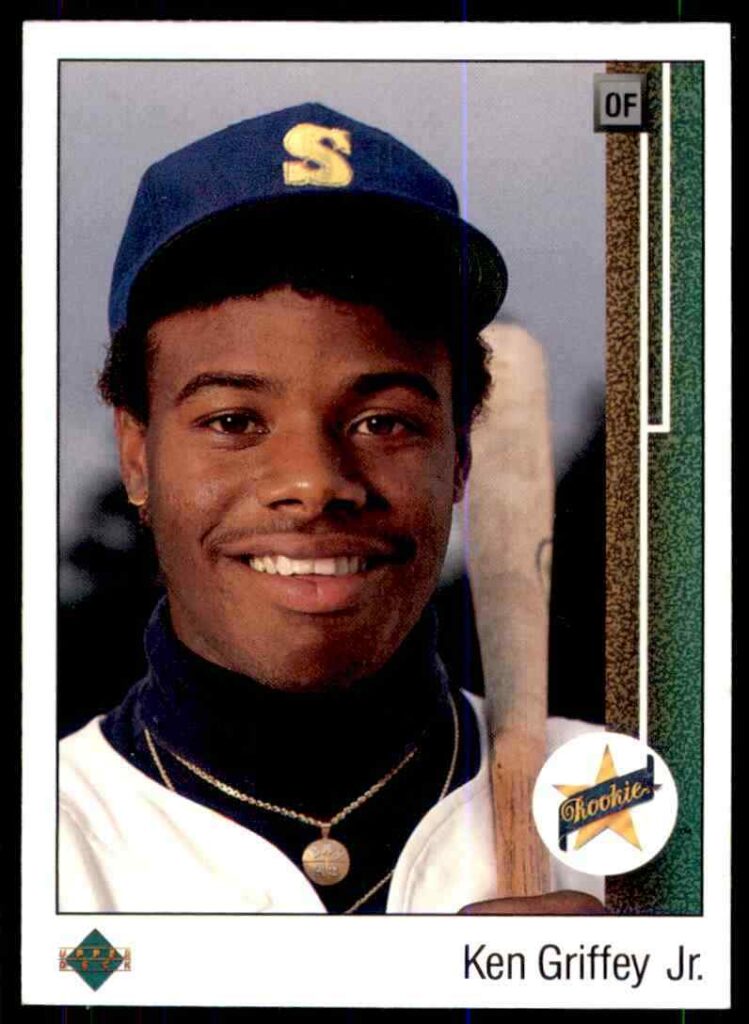
Every generation has its financial fantasy.
For our parents, it might have been buying a house before prices went insane. For us, it was the 1989 Upper Deck Ken Griffey Jr. rookie card.
That card was the centerpiece of the entire operation.
The smiling young Seattle Mariners outfielder, wearing his backwards cap, looked like the future of baseball. And, as it turned out, he was. Griffey became one of the greatest players of his generation, a 13-time All-Star, 10-time Gold Glove winner, and first-ballot Hall of Famer.
But to a 12-year-old in 1990, he was something even more important. He was the down payment.
The 1989 Upper Deck set was revolutionary in its own way. Upper Deck introduced higher-quality card stock, glossy finishes, hologram security features, and photography that made many traditional cards look like they had been printed on the back of a grocery receipt.
The Griffey rookie became the face of the modern baseball card boom.
And once that card became valuable, the rest of us started looking at every rookie card as a potential retirement vehicle.
We weren’t just collecting players. We were collecting future tuition payments.
Other cards became part of the financial conversation:
- 1985 Topps Mark McGwire: The Olympic Team USA rookie card that became a major collectible.
- 1984 Donruss Don Mattingly: A key rookie card for fans who believed the Yankees first baseman could do no wrong.
- 1983 Topps Tony Gwynn: A rookie card featuring one of baseball’s greatest pure hitters.
- 1982 Topps Cal Ripken Jr.: A card tied to the career of baseball’s Iron Man.
- 1987 Topps Barry Bonds: A rookie card from the era when everyone was hunting for the next superstar.
- 1989 Score Randy Johnson: A rookie card featuring the future Hall of Fame pitcher who eventually became impossible to miss, especially if you were a bird.
The problem was that we all wanted the same cards. And we all believed they would become priceless.
Fan Stop Nation’s Griffey Retirement Multiplier: 47.3 — the number of college semesters a kid believed one pristine Griffey rookie could cover, assuming the card shop owner wasn’t trying to cheat him.
“Ken Griffey Jr. is not just a baseball player. He’s a long-term financial instrument with a beautiful smile and excellent center-field range.”
Childhood asset allocation specialist

Binders, Plastic Sleeves and the Sacred Art of Protecting Our Investments

We didn’t just own baseball cards. We maintained them.
There was a process. A system. An entire set of rituals that would have impressed a museum conservator.
The best cards went into penny sleeves. The really good cards went into rigid plastic holders. The absolute treasures were placed in the binder, carefully arranged by team, player, or whatever organizational theory made sense to us that week.
We had three-ring binders with plastic pages. We had cardboard storage boxes. We had price guides. We had shoeboxes for duplicates, although “duplicate” was a generous term for the 46 copies of a player nobody wanted.
And we had rules.
- Never touch the front of a card with greasy fingers.
- Never bend a corner.
- Never leave cards in direct sunlight.
- Never let your younger sibling look through the binder unsupervised.
- Never trade a valuable card without consulting the price guide.
- Never, under any circumstances, admit that your collection might be worth less than you thought.
We became experts in condition before we understood the concept of a credit score.
Corners mattered. Edges mattered. Centering mattered. Surface mattered. A card that looked perfect to a normal human being could be dismissed as practically worthless because the photograph was printed three millimeters too far to the left.
We were learning the language of professional grading without realizing that the entire future of the hobby would eventually revolve around people arguing about whether a card deserved a 9 or a 10.
Fan Stop Nation’s Crisp Corner Index: 10.0. The maximum rating awarded to a card that had never been touched by human hands, sunlight, gravity, or a younger brother with a peanut butter sandwich.
“I once saw a kid put on cotton gloves to inspect a 1987 Topps Jose Canseco. The card was worth 40 cents. The gloves cost $8.50.”
Collectibles preservation and risk management consultant
The Price Guides: Our Bloomberg Terminal Was Printed on Newsprint
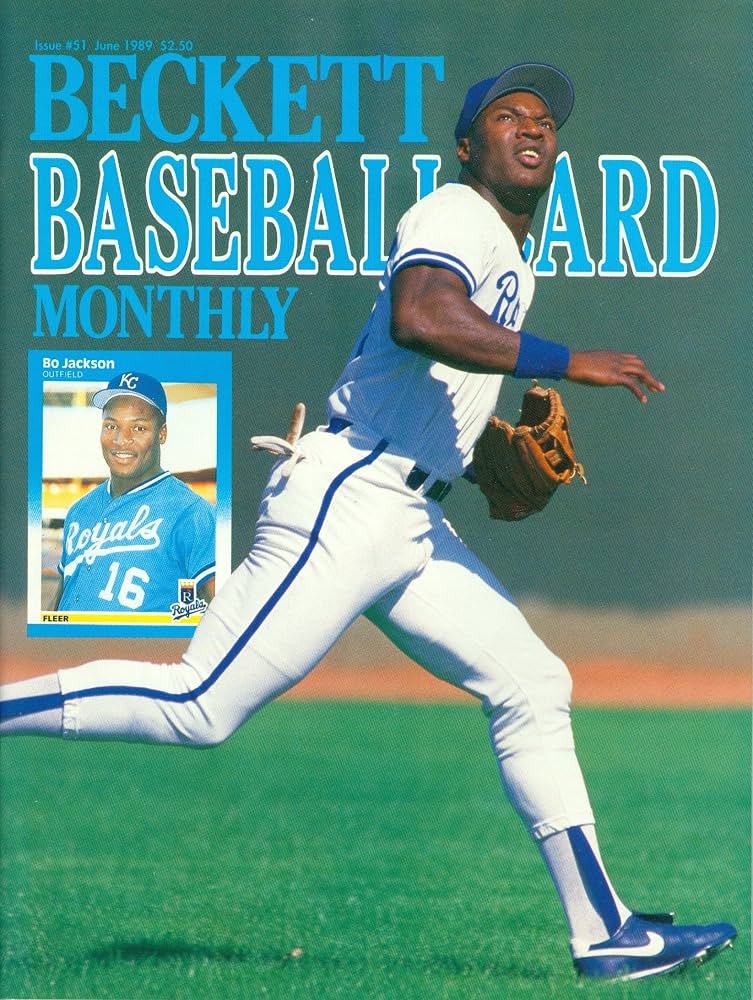
Before online marketplaces, population reports, and real-time sales data, we had price guides … and we trusted them.
Beckett Baseball Card Monthly was practically required reading. It was the financial bible of the hobby, the document that told us whether we were rich, poor, or somewhere between a rookie card and a complete set of 1990 Fleer.
We checked the prices constantly.
A card was worth $2. We checked again the next month. It was worth $2.50. We had just made a 25% return.
We were geniuses!
Of course, those listed prices were not necessarily what someone would actually pay. The price guide wasn’t a guarantee, an offer, or a binding financial agreement. It was a reference point. The difference between listed value and real-world selling price was a lesson we would learn later, usually while trying to unload a stack of cards at a shop that offered us enough money for a soda.
Still, the guides created a sense of legitimacy.
We had market values. We had monthly updates. We had rising and falling prices. We had charts.
We had no income, no expenses, no understanding of liquidity, and no way to explain why a card listed at $25 couldn’t be exchanged for $25.
But we had a price guide, and that was close enough to Wall Street.
Fan Stop Nation’s Beckett Believability Index: 99.1% of kids who accepted a printed card value as legally binding, regardless of whether anyone had ever paid that amount.
“According to the guide, this card is worth $18. I am willing to accept $17.50, plus a root beer, but I will not negotiate with someone who doesn’t understand market fundamentals.”
Youth collectibles trading desk analyst
The Junk Wax Era: When Everybody Started Printing Money
And then came the problem.
The baseball card companies noticed that everybody was buying cards. Not just kids. Adults were buying them. Investors were buying them. Speculators were buying them. People who hadn’t watched a baseball game since the Carter administration were buying them.
The industry responded like a Banana Republic economy … it printed more cards … a lot more cards!
The late 1980s and early 1990s became known as the Junk Wax Era, a period when manufacturers produced enormous quantities of cards to meet demand. Topps, Donruss, Fleer, Score, Upper Deck, and others were competing for collectors’ dollars.
New sets appeared. Special sets appeared. Glossy sets appeared. Traded sets appeared. Factory sets appeared. Limited editions appeared. Premium editions appeared.
Every company seemed to have discovered a new way to package the same 700 baseball players.
The problem with collectibles is that scarcity matters. If everyone has the same card, it’s difficult for that card to become exceptionally valuable.
Manufacturers were producing cards by the millions, sometimes far beyond what the market could realistically absorb. Nobody was thinking about supply and demand. We were thinking about finding another Griffey.
The industry was essentially operating a cardboard printing press while children around the country were making retirement projections.
Fan Stop Nation’s Wax Pack Supply Index: 1,000,000 unopened packs a kid believed he needed to purchase before the odds of finding a second Griffey rookie became statistically favorable.
“Demand is strong, production is stronger, and we have recently discovered that a warehouse can hold approximately 900 million cards featuring players nobody remembers.”
Baseball card manufacturing capacity planner
The 1990s Cardboard Apocalypse: When Our Portfolios Became Wallpaper
If you collected baseball cards in the early 1990s, you probably remember the moment when the excitement started to fade.
The packs were everywhere. The sets were enormous. The special editions were becoming less special. And suddenly, the cards we had been protecting like priceless artifacts weren’t exactly flying off the shelves.
There were cards everywhere.
In closets. Under beds. In garages. In basements. In shoeboxes. In binders stacked behind old Nintendo games and VHS tapes.
Many of the cards from this era remain inexpensive because so many were produced and preserved. A card featuring a Hall of Fame player can still be worth very little if there are thousands upon thousands of similar copies available in comparable condition.
And that’s where our financial plan encountered a slight complication. We had confused a famous player with a rare collectible.
We knew Nolan Ryan was one of the greatest pitchers ever. We knew Cal Ripken was a legend. We knew Frank Thomas was going to be a star. But the fact that a player was great didn’t automatically make every card featuring him valuable.
We had also confused owning a card with owning a market.
The shoebox wasn’t an investment account. It was a storage solution.
Fan Stop Nation’s Cardboard-to-Cash Conversion Rate: 0.8% average Junk Wax Era collection that could be converted into enough money to cover a tank of gas, assuming the buyer was feeling generous.
“I told my wife we had a diversified portfolio. She asked why it was all 1991 Fleer. I explained that diversification was a process, not a destination.”
Household cardboard asset manager
The Cards We Thought Were Rare (And the Ones That Actually Were)


One of the biggest lessons of the card boom was that not all cards were created equal.
We had spent years believing certain cards were rare because they were valuable in the price guide, difficult to find in our local card shop, or simply because our friends didn’t own one.
But scarcity is not the same thing as popularity.
Some cards really were important. Others were simply products of a hot market.
The distinction matters because the hobby has plenty of genuinely scarce, historically significant cards. The problem was that many of us were collecting during a period when mass production made scarcity increasingly difficult to find.
A few examples help illustrate the difference:
- 1989 Upper Deck Ken Griffey Jr.: A landmark modern rookie card, but not nearly as scarce as many collectors once assumed.
- 1984 Donruss Don Mattingly: A highly recognizable rookie from an era when demand was enormous.
- 1985 Topps Mark McGwire: A desirable rookie card whose long-term value depends heavily on condition and demand.
- 1952 Topps Mickey Mantle: A genuinely iconic vintage card, with historical importance and scarcity that modern mass-produced cards generally cannot match.
- T206 Honus Wagner: One of the most famous and scarce cards in the hobby, with a story and market history far beyond anything we were pulling from a wax pack in 1991.
- 1954 Topps Hank Aaron: A major vintage rookie card that illustrates what real historical scarcity can look like.
We didn’t necessarily need to know the difference when we were 11. We were having fun, and that was the point. But we did need to understand it before we started planning to pay for a four-year degree with a stack of 1990 Score.
Fan Stop Nation’s Actual Scarcity Recognition Index: 12.4% of collectors who could correctly identify a genuinely scarce card without first checking the price guide, asking a shop owner, or consulting a suspicious man at a flea market.
“There’s a difference between a rare card and a card nobody wants. Unfortunately, my entire childhood collection is currently being evaluated under the second category.”
Vintage collectibles market research director
The Card Shop: Our Version of a Stock Exchange
The local card shop was where everything became real.
It was part retail store, part trading floor, part social club, and part place where an adult man would explain why your best card wasn’t worth what you thought it was.
The walls were covered in display cases. There were boxes of singles organized by player or team. There were binders behind the counter. There were price guides, unopened boxes, protective holders, and usually at least one customer who looked like he had been waiting for a shipment of 1952 Topps cards since the Truman administration.
You could trade. You could buy singles. You could sell cards. You could spend an entire Saturday afternoon looking through boxes while the shop owner quietly questioned his life choices.
And there was always a hierarchy.
The serious collectors knew the difference between a rookie card and a second-year card. They knew which sets were worth chasing. They understood grading, condition, and the market.
The rest of us were trying to trade three mediocre cards for one good one while insisting that the other kid was getting the better end of the deal.
We also learned a painful lesson: the price a store charged for a card was not necessarily the price it would pay to buy that same card from you.
Apparently, the business of buying and selling collectibles involved a thing called a margin.
We considered this an outrageous betrayal.
Fan Stop Nation’s Card Shop Negotiation Index: 6.7 — The average number of minutes a 12-year-old could argue over a $1.50 card before being told to either buy it or move away from the counter.
“I’ve been in this business 22 years. I’ve seen market crashes, supply shortages, and grown men cry over a slightly off-center Bo Jackson. But I’ve never seen a kid negotiate harder over 35 cents.”
Independent sports card shop proprietor
So, Were We Completely Wrong? Not Exactly.
Here’s the thing: not every baseball card from our childhood became worthless.
But the market is different now, and collectors have access to far more information than we did. We had a monthly magazine and a guy at the card shop who claimed to know a guy.
The bigger lesson is that collecting should be about more than an imagined future payday. The memories, the excitement of opening a pack, the thrill of finding a favorite player, and the trading rituals were valuable in their own right.
We didn’t need a six-figure retirement account. We needed a reason to believe the next pack might contain something amazing. And for a few minutes, every time we opened one, it did.
Fan Stop Nation’s Nostalgia Appreciation Index: 99.9% of collectors who would happily open one more pack of 1989 Upper Deck, even if they knew the only thing inside was a checklist and a gum stain.
“I may not be able to retire on my collection, but I can still identify 1988 Topps design from across a room. That’s a skill the financial markets have yet to properly value.”
Senior cardboard nostalgia analyst
And then there was the gum: A Bonus Feature and a Dental Liability
Every pack of baseball cards came with a piece of gum that looked like it had been manufactured sometime during the Eisenhower administration and stored in a warehouse next to industrial adhesives.
It was usually pink. It was usually rectangular. It was almost always rock hard. And it had the structural integrity of a small piece of sidewalk.
But we ate it anyway.
We didn’t care that it tasted like sweetened cardboard, chalk dust, and the faint memory of bubble gum. It was part of the experience. You opened the pack, shuffled through the cards, admired your latest acquisition, and then considered whether your dentist would be available on Monday.
The gum was basically a participation trophy for surviving the pack-opening process.
There was also the occasional card with a mysterious gum stain, a slightly warped corner, or a sticky patch that made you question whether the previous owner had opened the pack during a heat wave.
Nobody was buying baseball cards for the gum. We were buying the gum because it came with the baseball cards. It was the original bundled subscription service.
Fan Stop Nation’s Gum-to-Card Ratio: 1:15 — The approximate number of seconds it took to chew the gum versus the 15 years we planned to hold the cards as long-term investments.
“I’ve seen a lot of things in this hobby, but nothing says childhood like a kid pulling a pristine rookie card out of a pack and immediately trying to determine whether the gum is still legally edible.”
Youth collectibles and dental risk management coordinator